Why the SENTINEL Matters
The SENTINEL is not a product Adams Industries sells. It's a product Adams Industries invented. Chris Adams designed the first ground combat ANVIS-style binocular night vision goggle — the architecture that every dual-tube ground combat NVG since has followed. When you buy a SENTINEL from us, you're buying it from the person who drew the original.
The Origin
Most binocular NVGs on the market today trace their architecture back to this design. Fixed bridge. Binocular optics. Ground combat optimized. The SENTINEL was the proof of concept that the industry turned into a standard.
Built to Order
Every SENTINEL is configured to your requirements. Tube selection, optics, and finishing are done to spec. This is not a shelf product. Contact us to discuss your build.
Thirty Years of Refinement
The design has been refined continuously since 1993. Current builds incorporate lessons from three decades of fielding, feedback, and engineering iteration. This is what thirty years looks like.
The Goggle That Started It.
Before the RNVG. Before the DTNVS. Before every articulating and fixed-bridge binocular that followed — there was the SENTINEL. Adams Industries does not make this claim lightly. The design heritage is documented. The fielding history is real. If you want the original, you know where to find it.
The SENTINEL: How It Began
ANVIS — Aviator Night Vision Imaging System — goggles had been the binocular NVG of record since the 1970s. Optimized for rotary-wing aviation use, the ANVIS sits close to the face, runs at unity magnification, and flips up when the pilot needs natural vision. On the ground, with a rifle, in close terrain, moving through doorways and vehicles, the aviation form factor was a workaround, not a solution. Ground operators using binocular NVGs were adapting aviation gear because ground-optimized binocular gear did not exist.
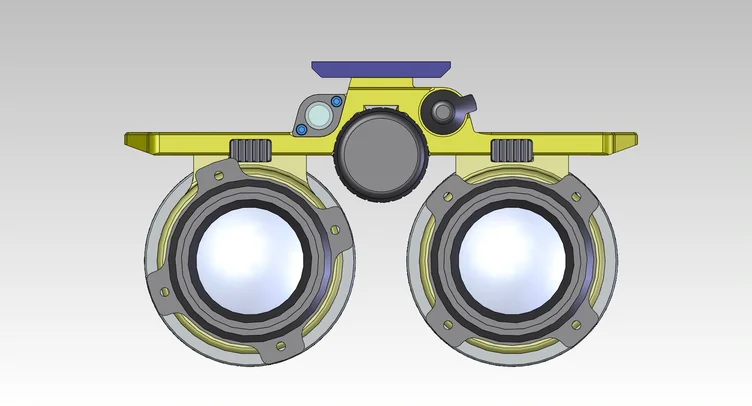
Chris Adams designed the SENTINEL to solve that problem. The core of the design was a fixed bridge — structurally different from the articulating bridge of the ANVIS, which allowed the left and right optic housings to move independently. A fixed bridge trades that adjustability for stability. On the ground, stability wins. The housing geometry was redesigned for ground combat: different mounting interface, different diopter range, different ergonomic assumptions. The result was a binocular NVG built specifically for the dismounted operator rather than adapted from a cockpit design.
That architecture — fixed bridge, binocular optics, ground combat geometry — is now the standard. Every dual-tube ground combat NVG that followed the SENTINEL uses the same basic structural logic. The RNVG, the DTNVS, the Katana, the other fixed-bridge binocular goggles that now define the high-performance tier of the market — they all trace their lineage to the same design decisions the SENTINEL made first. Adams Industries does not make this claim lightly. The fielding history and design heritage are documented going back to 1993.
The current SENTINEL is not the 1993 SENTINEL. Thirty years of fielding feedback, manufacturing improvements, and engineering iteration are in the design. The optics package has been updated. The housing manufacturing has been refined. What has not changed is the fundamental architecture, because the fundamental architecture was right from the beginning. When you buy a SENTINEL from Adams Industries, you are buying from the person who drew the original — not from a company that reverse-engineered what Adams Industries proved was possible.
Get a Quote on the SENTINEL
Pricing and configuration on request. Tube options from Gen 3 Elbit and L3/Harris. Contact us to discuss your build requirements.
Ask Questions on WhatsApp Schedule a Consultation Learn why we changed our order process to better protect you.System Specifications
| Design | Fixed-bridge binocular, ground combat optimized |
|---|---|
| Magnification | 1x (unity) |
| Field of View | 40° standard |
| Diopter Range | -6 to +2 |
| Tube Compatibility | MX-11769 / MX-10160 |
| Optics | Mil-Spec and RPO ultralight available |
| IR Illuminator | Built-in |
| Power Source | CR123 battery |
| Housing Material | Aluminum alloy |
| Export Control | ITAR / EAR — U.S. persons only |
SENTINEL — Frequently Asked Questions
What is the SENTINEL night vision goggle?
The SENTINEL is a dual-tube binocular night vision goggle designed and built by Adams Industries since 1993. It uses two independent Gen 3 image intensifier tubes — one per eye — to deliver true stereoscopic night vision with natural depth perception. Chris Adams designed the original SENTINEL as the first ground combat-optimized binocular NVG, adapting the ANVIS aviation concept for dismounted operator use. Every fixed-bridge binocular NVG on the market today follows the architectural template the SENTINEL established.
Who is the SENTINEL designed for?
The SENTINEL is built for law enforcement tactical units, military operators, and security professionals who require sustained binocular NVG capability. It is also the choice for serious civilian users who want the depth-perception and eye-fatigue advantages of a dual-tube system and are not interested in a monocular compromise. The SENTINEL has been fielded by both military and law enforcement units since the 1990s. Every build is to order — tube selection, optics, and configuration are done to your requirements.
What tube options are available in the SENTINEL?
The SENTINEL accepts MX-11769 or MX-10160 compatible Gen 3 image intensifier tubes from Elbit Systems of America or L3 Harris Technologies. Builds are available in Aviation, Professional, or Field Grade. Adams Industries provides individual tube spec sheets with every unit — FOM, SNR, EBI, and center resolution — and matches tube pairs to ensure balanced image quality between eyes. Mismatched tube pairs are a common source of eye fatigue in binocular NVGs; this is a detail Adams Industries takes seriously.
Is the SENTINEL legal for civilians?
Yes. The SENTINEL is legal for US civilian purchase for domestic use. Night vision is ITAR-controlled under Category XII — it cannot be exported without a State Department license and cannot be transferred to foreign nationals even on US soil. Domestic purchase by US citizens and lawful permanent residents is legal. Adams Industries (CAGE 1SMP2) manages all compliance documentation. We do not ship outside the United States.
What makes the SENTINEL different from a PVS-14 monocular?
The PVS-14 is a monocular — one tube, one eye — which preserves the other eye for natural light awareness and is lighter and less expensive. The SENTINEL is a binocular — two tubes, two eyes — delivering stereoscopic vision with natural depth perception to both eyes simultaneously. The binocular format reduces eye fatigue on extended operations and improves situational awareness in complex terrain. The SENTINEL is the step up for operators who need sustained binocular performance rather than the versatility of a monocular.
How does the SENTINEL compare to a panoramic night vision goggle?
The SENTINEL is a fixed-bridge binocular — two tubes, approximately 40° field of view per eye, standard stereo NVG format. A panoramic NVG (like the GPNVG-18 or Adams Industries PANOS) uses four tubes in a fan configuration to deliver roughly 97° of effective horizontal field of view — more than double the SENTINEL's coverage. Panoramic NVGs are significantly more expensive because they require four matched tubes. The SENTINEL is the right choice for binocular performance at a two-tube price. If wide situational awareness and peripheral coverage are the priority, see the Adams Industries PANOS.
The One That Started Everything.
If you want to know what the original ground combat binocular NVG looks like in 2026, contact us. We'll talk through your build requirements and get you configured correctly.