
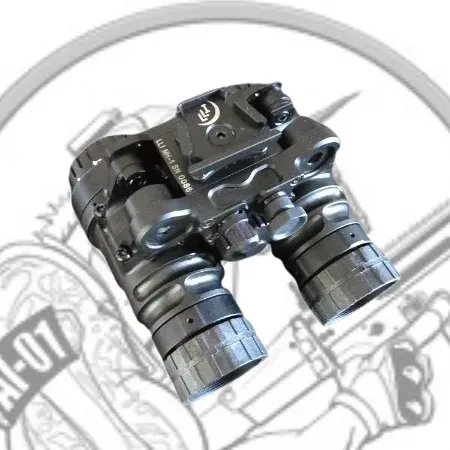
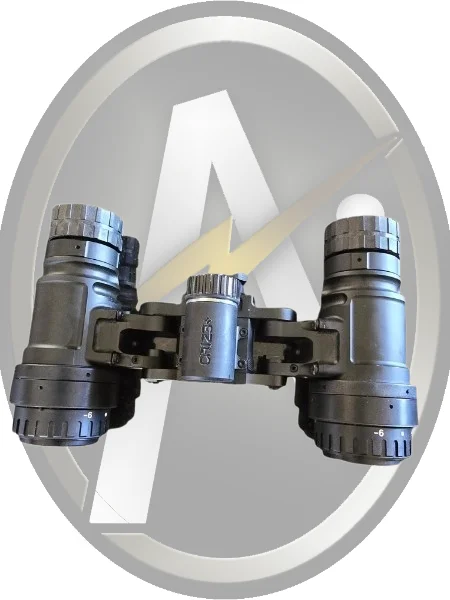
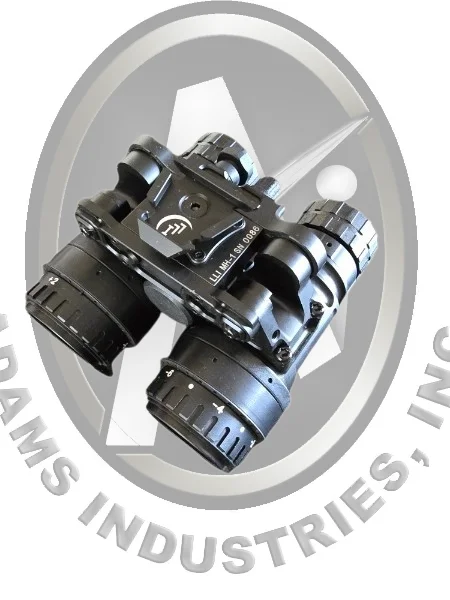
MH-1 Night Vision Goggle
A rugged, lightweight, and fully adaptable binocular goggle system engineered for serious low-light work. Configure optics, tube package, housing color, and optional UBC power the Adams way.
Built by Adams Industries on the LLI MH-1 housing, with Fuji mil-spec optics and Gen 3 image intensifier tubes from L3Harris or Elbit Systems of America, selected and matched by Adams Industries.
Start Your Build NowWhy the MH-1 is Different
The MH-1 is a modular dual-tube goggle platform built for buyers who want a serious binocular system without locking themselves into a dead-end housing. Manual gain capability, modular power, PVS-14 optics compatibility, and a magnesium-and-titanium housing mean you're not choosing between rugged and adaptable. You get both, and you keep the option to reconfigure as your mission changes instead of buying a new goggle.
Ultimate Modularity
The MH-1 is built around a modular pod ecosystem. It starts life as a dedicated articulating goggle, but the platform is engineered to support bridge conversion, pod-level flexibility, and future changes in power and accessory setup without turning the housing into a science project.
Rugged Yet Lightweight
The MH-1's housing is magnesium alloy and titanium hardware, 460 grams configured. That's real weight savings where it matters most, on your head, hour after hour, without giving up the durability a working goggle actually needs.
Feature-Rich Architecture
Manual gain capability, dual-output IR illumination, rotational pod shutoff, and IPD stops put the MH-1 in the category of actual working goggles instead of stripped housings pretending to be premium. The platform also accepts both MX-10160 and MX-11769 tubes and standard PVS-14 pattern optics.
Complete Systems Only
We are not selling an empty shell. This page is for complete MH-1 systems only, configured with your selected tubes and optics: hand-selected image intensifier tubes, your chosen optics, individual spec sheets, and a hard carrying case, ready to mount and go.
A Goggle That Grows With the Mission
The MH-1 was designed as a real platform, not a goggle that checks one spec-box better than the next guy's. Modular power, bridge conversion, tube-format flexibility, PVS-14 optics compatibility, optional UBC integration, and panning-arm compatibility all come standard. Configure it for the mission in front of you now, and reconfigure it for the next one instead of buying a new goggle.
Configure Your MH-1
Every unit from Adams Industries is built to order — like it should be...
Step 1: Choose Your Optics
Step 2: Choose Your Image Intensifier
Step 3: Choose Your Housing Color
Step 4: Universal Battery Compartment (UBC)
Current pricing is configuration-dependent. Send your build and we will quote the exact unit.
Learn why we changed our order process to better protect you. Learn why we changed our order process to better protect you.System Specifications
| Power Source | Modular (CR123A, AA, external optional) |
|---|---|
| Operation Time | 25–90 hours depending on configuration |
| Magnification | 1x (unity) |
| Focus Range | 9.8 inches to infinity |
| Field of View | 40° |
| Diopter Adjustment | -6 to +2 |
| Interpupillary Adjustment | 51–78mm |
| Eye Relief | 25mm |
| Tube Compatibility | MX-10160 / MX-11769 |
| Optics Compatibility | PVS-14 eyepiece & objective lenses |
| Water Resistance | Submersible to 66 ft for 2 hours |
| Housing Material | Magnesium alloy + titanium hardware |
| Weight | 460g configured |
| Included With Complete Systems | Hand-selected tubes, chosen optics, spec sheets, and a hard carrying case |
| Export Control | ITAR / EAR Category XII(a)(1) – U.S. persons only |
MH-1 Night Vision Goggle — Frequently Asked Questions
What is the MH-1 night vision goggle?
The Low Light Innovations MH-1 is a modular dual-tube binocular goggle platform configured by Adams Industries. It features manual gain control, modular power (CR123A, AA, or optional external), articulating pods with rotational shutoff, dual-output IR illumination, and IPD stops. The housing is magnesium alloy and titanium hardware at 460g configured. It accepts MX-10160 and MX-11769 format tubes and is compatible with standard PVS-14 pattern optics. Complete systems include hand-selected image intensifier tubes, chosen optics, spec sheets, and a hard carrying case.
How does the MH-1 compare to the PVS-14?
The MH-1 uses two independent Gen 3 tubes for true binocular vision — separate images per eye, full stereoscopic depth perception. The PVS-14 is a single-tube monocular — one eye, no depth perception, but significantly lighter and weapon-mountable. The MH-1's binocular format reduces eye fatigue on extended operations and provides better depth cues for vehicle operation, climbing, and CQB navigation. The PVS-14 is the right choice when weapon-mount capability or minimum weight is the priority. The MH-1 is the right choice for sustained dismounted binocular performance.
Can civilians buy the MH-1?
Yes. The MH-1 is legal for US civilian purchase for domestic use. Night vision is ITAR-controlled under Category XII — it cannot be exported without a State Department license and cannot be transferred to foreign nationals even on US soil. Domestic purchase by US citizens and lawful permanent residents is legal. Adams Industries (CAGE 1SMP2) handles all compliance documentation and verifies US person status before any unit ships. We do not ship outside the United States.
What tube grades are available in the MH-1?
Adams Industries configures the MH-1 with Gen 3 tubes from Elbit Systems of America across multiple FOM tiers (1600–2000, 2001–2376, 2377–2600, 2601+) and from L3 Harris Technologies (standard filmless, high-performance filmless, and the Supergain). Tube pairs are hand-selected and matched for balanced image quality between eyes — mismatched pairs are a documented source of eye fatigue in binocular systems. Every unit ships with individual tube spec sheets. Contact us for current inventory and pricing.
What are the MX-10160 and MX-11769 tube formats, and what is the difference?
The MX-11769 and MX-10160 are both 18mm format Gen 3 image intensifier tubes — the same physical dimensions and pin-out. The MX-11769 is the tube format used in the AN/PVS-14, PVS-7, and most 18mm-format NVG housings. The MX-10160 is the format used in the AN/AVS-6 and similar aviation NVGs. In the MH-1 housing, both formats are mechanically compatible. The image quality difference between equivalent-grade MX-11769 and MX-10160 tubes from the same manufacturer is negligible — what matters is the tube's documented FOM, SNR, and EBI, not the suffix designation.