Omni 7 vs Omni 8 PVS-14 Tubes: What the Numbers Actually Say
Shop long enough for a PVS-14 image intensifier tube and you will run into "Omni VII" (Omni 7) and "Omni VIII" (Omni 8) offerings, and opinions about which is better are both varied and strong - like coffee should be!. People often speak of the two as though they are part of a grading system. Higher number, better tube, pay more. Dealers rarely correct that impression, and I understand why. It is a convenient thing to pass along when you have Omni VIII tubes in inventory and educating people on a topic that seems to contradict itself is never easy.
I have been buying and selling tubes since 1993, I had some of the first legal-to-own* Omni VII tubes that hit the market, and I have two things to tell you about Omni tubes.
First: Omni Is a Contract, Not a Performance Grade
Omni is short for Omnibus. These are US Army omnibus procurement contracts, and the Roman numeral tells you which contract a tube was bought under. It does not tell you how good the tube is.
An MX-11769 built in 2006 and an MX-11769 built in 2020 are, on paper, close to the same tube. More often than not, however, they will perform quite differently. If somebody sells you an MX-11769 and calls it "an Omni VII tube" because it was purchased under the Omni VII contract, they have told you the invoice it was on, which indicates the minimum acceptable specifications for that tube. This literally means that the minimum performance under that contract of 25 signal-to-noise ratio can apply to both the first tube delivered under that contract, the last tube delivered, and every tube in between. Also: there are no individual production tube sheets for Omni tubes. Uncle Sam threatened the manufacturers with horrible punishments if they delivered tubes that did not meet or exceed the minimums, so then why would the government want about a million pounds of tube sheets to throw away? As a result, the only Omni tubes that come with tube data sheets that we know of, are the rebuilt ones available from Adams Industries, Inc.
Second: Omni VIII Did Not Raise the Bar. It Lowered Parts of It.
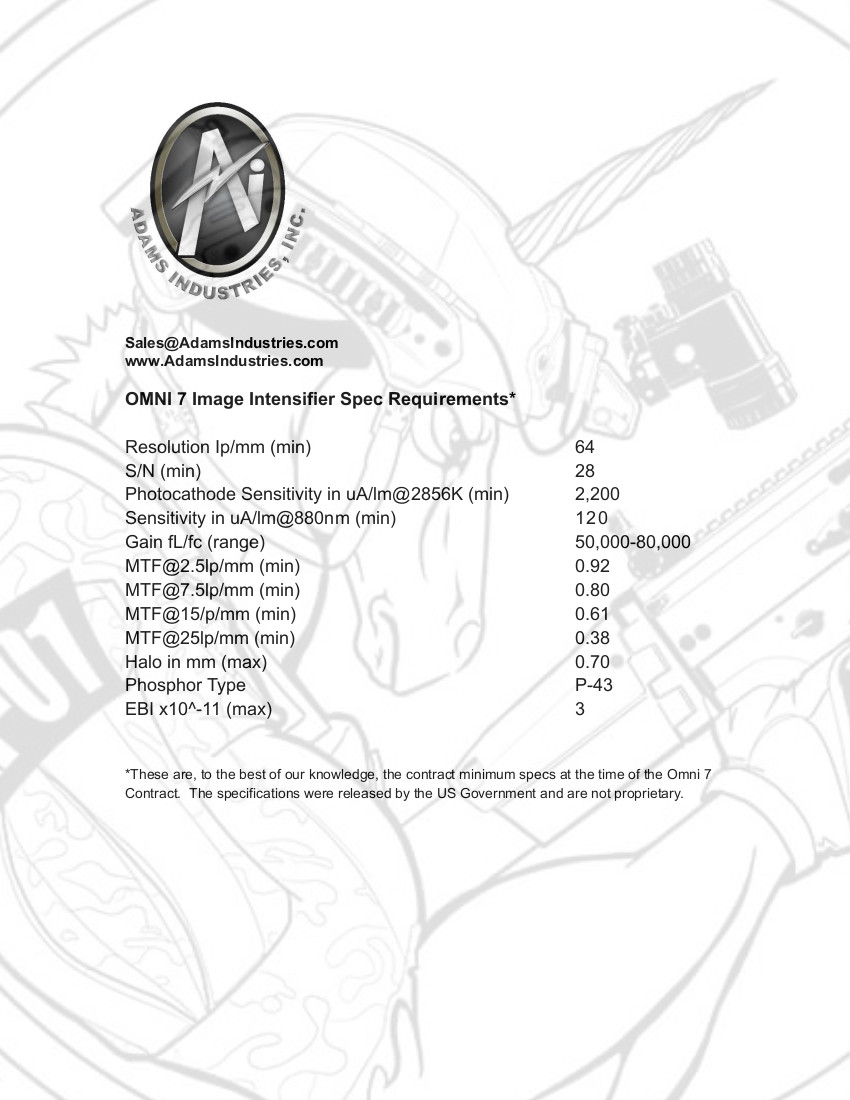
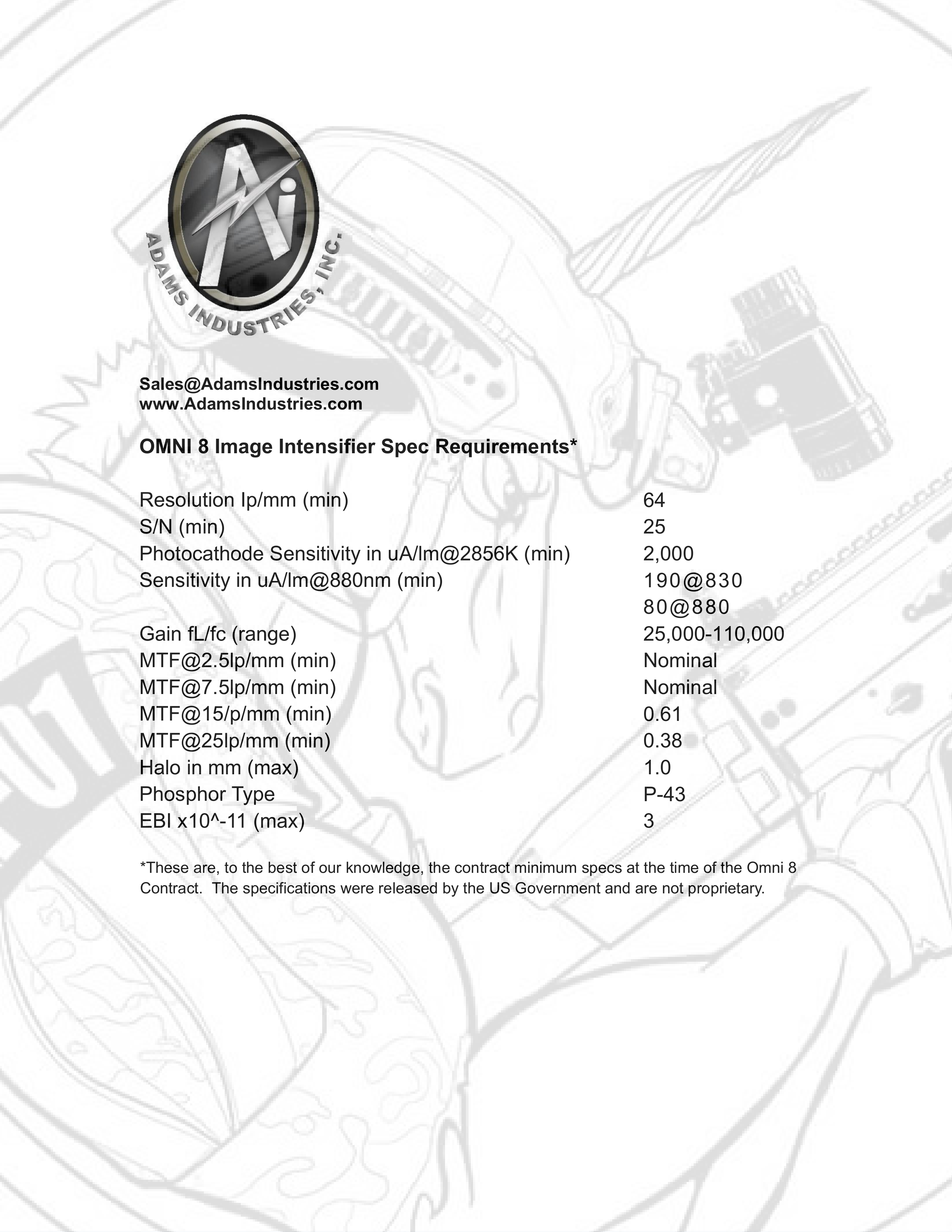
Taking the published contract minimums for the MX11769 family, here is Omni VII against Omni VIII:
| Spec | Omni VII (2006) | Omni VIII (2010) |
|---|---|---|
| Signal-to-Noise Ratio | 28 min | 25 min |
| Resolution | 64 lp/mm | 64 lp/mm |
| Photocathode sensitivity (µA/lm @ 2856K) | 2200 min | 2000 min |
| Halo | 0.70 mm max | 1.0 mm max |
| Gain (fL/fc) | 50,000 to 80,000 | 40,000 to 80,000 |
| EBI (x10⁻¹¹) | 3 | 3 |
Read that table again. On signal-to-noise, on photocathode sensitivity, on halo, and on the bottom of the gain range, the Omni VIII contract minimums sit at or below Omni VII. Halo actually got worse by a third of a millimeter, and halo is what determines how ugly a streetlight looks at two in the morning.
Omni VII was an unusually demanding contract. It is the one that brought autogated thin-film to the standard and effectively replaced what the US had been calling Gen 4.
Now, before you go swearing off Omni VIII entirely, understand what a minimum is and is not.
The Minimum Acceptable Spec Is Just That
A contract minimum is the worst tube the government agreed to accept. It is not what showed up in the crate. Tubes routinely test well above the floor of whatever contract they were sold under, and late-production Omni VIII tubes are almost universally way above their minimums. Not slightly. Way above.
Omni VIII's reputation problem among people who read the specs comes down to money.
The government paid more for Omni VII, so while both contracts were running, factories sent every tube that qualified for Omni VII into Omni VII, where the margin was better. Omni VIII, during the overlap, got what was left after the cream had been skimmed off.
Then Omni VII deliveries stopped. The skimming stopped with them, and Omni VIII quality came up fast, because now the good tubes had nowhere else to go.
The practical consequence for a buyer is this. An early Omni VIII tube, bought while Omni VII was still soaking up the best output, can genuinely disappoint you next to an Omni VII of the same era. A late Omni VIII tube is a different animal, and pricing it as though it were the early stuff is leaving performance on the table.
Which means the Roman numeral by itself has never been the useful question. Ask for the manufacture date which may still be on the tube sticker, but often that sticker has gone missing over the years. Nobody seems to know why… In the end, we really are back to “look through the damn thing and decide if you like what you see.”
Other Ways to Rank Tubes
Omni Contracts deliver, or in the cases of Omni VII and VIII delivered, products that met a particular specification on the day they were handed to the government. From that day on, those products are getting older, experiencing use, perhaps abuse, and they might even get blown up a couple times. So, when you are looking to buy a tube that could be coming up on its 21st birthday, and may have seen a life of constant combat or perhaps was never even installed in a goggle, that is when grading is important.
The first thing you have to understand is there is NO STANDARD that we all grade tubes by. The only mostly universal rule is that A and B grade tubes shouldn’t have any visible cosmetic blemishes in zone 1. It is also universally accepted that tubes with even one unstable bright spot (twinkling is how I describe it) are going to die sooner than later. Other than that… read what people are judging their own product by. This is how I judge mine:
| Grade | What It Means | Who Buys It |
|---|---|---|
| Aviation Grade (A Grade) | Top performers. Highest SNR, lowest EBI, cleanest image, fewest cosmetic blemishes. | Law enforcement, military supplement purchases, people who want the best and will pay for it. |
| Professional Grade (B Grade) | Meets spec, solid performers. Slightly lower measured scores than Grade A. May have minor cosmetic specs or slight edge-of-field variation. | Practical buyers who want excellent performance without Grade A pricing. The sweet spot for most civilian users. |
| Field Grade (C Grade) | Functional, meets minimum spec. More blemishes, lower measured scores. Some haze or edge distortion possible. | Budget-constrained buyers. Entry-level use. Not recommended for primary duty or tactical use. |
| Value Grade (V-Grade) (D, Fallout) | Low SNR, FOM can be as low as 1000. Well below the grades above and honestly described as such. | Experimenters, bench work, and medium-light applications. See the note below before you consider one. |
Our standard grades run from Aviation Grade to Field Grade, and that is the range most buyers should be shopping in.
Value Grade (V-Grade) Tubes - Beauty is in the Eye of the Beholder
V-Grade tubes exist, they are cheap, and they fill a need that you probably do not belong to.
Do not buy a V-Grade tube for night vision hunting without illumination. You need to positively identify an animal and place a shot precisely. In dark conditions, a FOM around 1000 will let you down on both counts.
Where a V-Grade tube does make sense is anywhere you have light to work with and no life riding on the image. Bench experimenting and learning the technology. Medium-light surveillance. Urban work where the city glow never really goes away and you are not fighting for every photon.
Closing Thoughts on Omnis and Grades
An Aviation Grade (A) Omni VII tube beats a Field Grade (C) Omni VIII tube every time. The contract sets a floor, but neither the government nor the original manufacturer ever assigned any tube a grade. If you can get a grade from somebody you trust, that is helpful. There is no tube sheet on an Omni tube, so you have to use every bit of information that you can get and don’t forget one thing: if you take the unit out on a dark night and it outperforms all the others you’ve seen, stop talking and pay the man. I’m going to keep talking about “grade” but remember that it can also be simply a reference to the relative quality and performance of a singular tube.
If you want the grade and phosphor you're after without gambling on an unknown commodity, see our rebuilt tube offerings, or call us with what you're looking for.
See Rebuilt Tube Offerings →Frequently Asked Questions
What is an Omni image intensifier tube?
An Omni tube is a night vision image intensifier tube purchased under one of the US Army's Omnibus procurement contracts, such as Omni VII or Omni VIII. The name tells you which contract the tube was bought under, not how good the tube is. Ask for the grade and the data sheet, not just the contract number.
Is an Omni VIII tube worth paying extra for over Omni VII?
It depends on when the tube was made. The published Omni VIII minimums are not above Omni VII's, and on halo and photocathode sensitivity they sit slightly below. But minimums are a floor, and late-production Omni VIII tubes typically test far above theirs. Ask for the manufacture date before you decide.
Can I put an Omni tube in my existing PVS-14 housing?
Yes. Omni VII and Omni VIII tubes are the same 18mm format and drop into any standard PVS-14 housing. If your PVS-14 needs a fresh tube rather than a whole new unit, we handle tube swaps and full overhauls.
Where can I buy a rebuilt Omni tube with a real data sheet?
Adams Industries stocks rebuilt Omni-family tubes in Aviation through Field Grade, each sold with its own measured data sheet. See our rebuilt tube offerings.
Build a complete PVS-14 around the right tube: