
The Crazy World of L3 Tubes — L3 Harris Image Intensifier Tube Specs
L3 Warrior Systems Image Intensifier Tube Specifications Overview & Summary
Compiled & Comments by Chris Adams, Adams Industries, Inc.
Don't forget to check out our specials!
So your journey in the night vision world has landed you on the doorstep of wanting a system with L3 tubes in it. It doesn’t really matter if you’ve taken the long road working your way through various stages of investment, or if you are the type who has decided to “buy once cry once;” the end result is that you’re about to spend what most people consider a lot of money on what will be called a tool or a toy, depending on who you show it to. This piece is in no way meant to condemn or validate your choice. You’re here and you need information; that’s good enough.
You have likely noticed that there is no well structured way of choosing what would be best for you. There is no helpful hand holding by the manufacturer and certainly no “plain talk” summary from a “legitimate source.” There are a bunch of dealers doing their best to sell complete L3 systems and systems containing L3 image intensifiers. Some of them are completely upfront, some of them are less so. Let’s start with the base of this reality.
Thanks for reading Night Vision & Tech by Adams! Subscribe for free to receive new posts and support my work.
The Crazy Crazy World of L3 Tubes
The people who buy direct from L3 are fearless champions of industry who agree to receive a certain number of tubes from one or a variety of designations–and they are literally gambling. Why so? It’s all due to two words that can cause Christmas level glee or dog-just-died pain and remorse: Unlimited FOM.
When you, or more likely the dealer you’re talking to, sign the dot on a PO, it’s for a particular quantity of a particular part number(s). You pay by the part number. So you can go all “put it all on 7!” if you’re a gambler and place an order for whatever the lowest “unlmited FOM” tube is available today and you might win big, or you might get a batch of tubes with the lowest spec acceptable by the lowest spec tube. Similarly you can spend the big bucks on 24UM tubes, and if they’re good, then you have good premium tubes. If they’re bad, then you can try and use their part number to at least try and break even. Like I said: gambling.
Before I go on to the next section, I want to add that I have personally verified that there are now 24U tubes available. They come as 24UM, which are the standard; 24UA, which are aviation grade with better cosmetic tolerances; and 24UAH “Supergain,” which are touted to be the best of the best.
The result of this is that most dealers choose one of two methods to sell their tubes. Some stick with the part numbers. “You are buying a 20UA tube and here is the tube sheet.” Pretty cut and dry, and you can decide mostly based on if you think the FOM is adequate for what you’re paying.
The other possibility is that your dealer may sort them by FOM. So, for example, they may have an 1800+ FOM category and a 2000+ FOM category. In this case you need to decide mostly if the other tube specs are good for you. If the photoresponse is terrible, then an amazing FOM isn’t that amazing. I don’t think there’s anything wrong with this with one caveat. Personally, I don’t recommend joining two tubes with different part numbers, even if the FOMs are identical. Some might call it undue caution, but I look at it this way: the US Government will not allow ALSE shops to combine two tubes from the same contract that have different CAGE codes (meaning different manufacturers). Now, these tubes are contractually obligated to be IDENTICAL, but Uncle Sam has found reason to keep them separated. I take that to the next level and feel safe that I may be overcautious, but I’m never going to be wrong.
Full disclosure: I do it both ways because I think you’re an adult and can make grown up decisions. It’s my job to give you a mind-choking amount of information to base that decision on.
This is where my “color commentary” comes to an end. What follows is a simple regurgitation of the information found on publicly available sources. I did add product example links, and they are so obvious as to not warrant mentioning, but I’m just going for complete transparency. If you have any questions about products that contain these tubes, please feel free to contact us at https://adamsindustries.com/contact. Same applies if you find mistakes or have any information that needs to be added. While this document has a publish date, it can always be updated.
Without further delay, let’s go onto the summary of all the information we could find on L3 tubes as of April 28, 2025:
Document Reference: N-EOPPS-1580 (Rev. M, 2015) Cleared for Public Release: DoD/OSR, 16-S-0372, Nov 20, 2015
Summary
L3 Warrior Systems (now L3Harris) developed a performance specification system for its Gen III night vision image intensifier tubes. These tubes are categorized into different series based on performance: 1400, 1600, 1800, 2000, and 2200 series. The specification document N-EOPPS-1580 outlines the minimum acceptable values for key optical and electrical performance parameters.
Key Parameters Defined:
Power Supply: Gated or DC (not gated)
Image Intensifier Type: Unfilmed or Filmed
Photocathode Sensitivity (@ 2856K, 50K): In μa/lm
Signal-to-Noise Ratio (SNR)
Center Resolution (lp/mm)
High Light Resolution (lp/mm)
FOM (Figure of Merit): Resolution × SNR
Halo (mm)
Since the N-EOPPS-1580, the 2400 Series / 24UM, 24UA, 24UAH:
We have no official specs for these tubes because an updated version of the N-EOPPS-1580 has not been circulated. We know they exist because we have held them in our hands. The common consensus is that the minimum FOM for the 2400 series is 2160. Our samples have yielded an average of 2520. Here are some examples of 2400 series based products: https://adamsindustries.com/products/l3-2400-series-24um-24ua-24uah-tube-based-products
Series Overview (from N-EOPPS-1580):
2200 Series / 22UM, 22UA, 22UAH, 22LM, 22LA
Power Supply: Autogated
Image Intensifier Type: Unfilmed
Photocathode Sensitivity: 2,000 min. (U)
SNR: ≥30.0 (U)
Center Resolution: ≥64 lp/mm
High Light Resolution: ≥36 lp/mm
FOM Max: Unlimited (U), 2200 (L)
FOM Min: “Not Applicable” (U), 1920 (L)
Halo 1.00 max (U), 0.85-1.10 (L)
Notes: Our average calculated FOM for the 2200 series, based on all the samples we could obtain, was 2428.
2000 Series / 20UM, 20UA, 20UAH, 20LM, 20LA
Power Supply: Autogated
Image Intensifier Type: Unfilmed
Photocathode Sensitivity: 2,000 min. (U)
SNR: ≥28.0 (U)
Center Resolution: ≥64 lp/mm
High Light Resolution: ≥36 lp/mm
FOM Max: Unlimited (U), 2200 (L)
FOM Min: “Not Applicable” (U), 1920 (L)
Halo 1.00 max (U), 0.85-1.10 (L)
Notes: Our average calculated FOM for the 2000 series, based on all the samples we could obtain, was 2570. Our sampling for this level was less than others and should be viewed with a little skepticism.
https://adamsindustries.com/products/l3-2000-series-20um-20ua-20uah-tube-based-products
1800 Series / 18UM, 18UA, 18LM, 18LA
Power Supply: Autogated
Image Intensifier Type: Unfilmed or Filmed
Photocathode Sensitivity: 1,800 min. (U)
SNR: ≥26.0 (U), 24.1 (L)
Center Resolution: ≥64 lp/mm
High Light Resolution: ≥36 lp/mm
FOM Max: Unlimited (U), 1800 (L)
FOM Min: “Not Applicable” (U), 1540 (L)
Halo 1.00 max (U), 0.85-1.10 (L)
Notes: Our average calculated FOM for the 1800 series, based on all the samples we could obtain, was 2200. Of note is that this is the only grouping where the UA version noticeably outperformed the UM version with an average of 2453.
https://adamsindustries.com/products/l3-1800-series-18um-18ua-tube-based-products-180308038
1600 Series / 16UM, 16UA, 16LM, 16LA
Power Supply: Autogated or DC
Image Intensifier Type: Filmed
Photocathode Sensitivity: 1,500 min. (U)
SNR: ≥ 21.9
Center Resolution: ≥64 lp/mm
High Light Resolution: ≥36 lp/mm (U), ≥12 lp/mm (L)
FOM Max: Unlimited (U), 1600 (L)
FOM Min: “Not Applicable” (U), 1400 (L)
Halo 1.25 max (U), 0.85-1.125 (L)
1400 Series
Power Supply: DC
Image Intensifier Type: Filmed
Photocathode Sensitivity: 1,350 min.
SNR: ≥ 19.0
Center Resolution: ≥64 lp/mm
High Light Resolution: ≥12 lp/mm
FOM Max: 1400 (L)
FOM Min: “Not Applicable” (U), 1216 (L)
Halo 1.25 max (U), 0.85-1.125 (L)
Document Notes:
"U" = Unlimited (Domestic), no FOM/Halo limit.
"L" = Limited (Export), with restricted FOM and looser halo resolution.
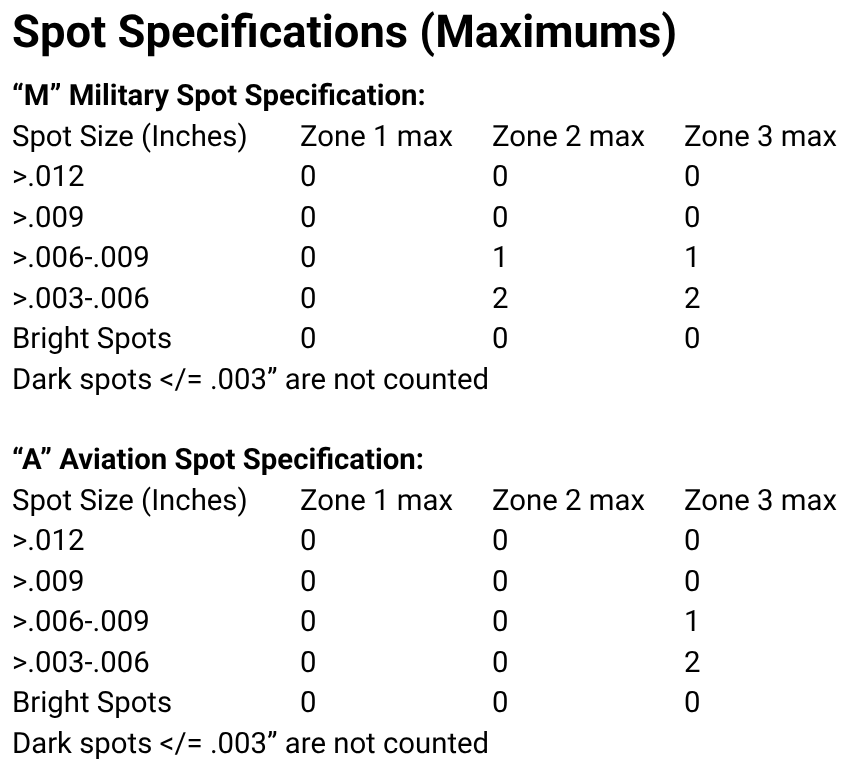
“M” = Military Spot Spec
“A” = Aviation Spot Spec
White phosphor tubes have slightly lower SNR requirements than green phosphor.
Contract-Specific, Legacy, Unofficial, & Unverified Specification Documents
Beyond the standard product lines covered by N-EOPPS-1580, L3 has issued variant or contract-specific performance specs designated by other N-EOPPS numbers. These often correspond to particular U.S. military procurement contracts (OMNI programs) or special use-cases (e.g. aviation tubes, “fallout” high-performance lots). Below are known examples:
N-EOPPS-1217: Custom 24UA tubes. Specifications believed to be: SNR 36 min, Center Resolution 64 lp/mm min, FOM 2304 min (calculated), HALO 1.0 max, and have an “A” Aviation Spot Spec.
N-EOPPS-1417: A specification associated with the AN/PVS-24 Clip-On Night Vision Device (CNVD) program. Tubes built for the PVS-24 (MX-11769 format, variable gain) carried data sheets referencing N-EOPPS-1417, indicating a contract-specific performance standard circa early 2010s. In practice, this spec produced tubes equivalent to standard MX-11769 Gen3 filmless tubes of that era (roughly OMNI VI/VII performance). N-EOPPS-1417 is a legacy document and not publicly available online; its existence is noted in forums via tube data sheet readings (e.g. a PVS-14 from Adams Industries marked “Contract/Spec: N-EOPPS-1417 (CNVD)”snipershide.com). This shows L3’s practice of using N-EOPPS numbers as contract identifiers on official tube spec sheets.
N-EOPPS-1594 and 1597: These specification numbers have appeared in community discussions and likely correspond to late-2010s contract specs (possibly related to OMNI VIII/OMNI IX programs or special runs, potentially distinguishing green vs. white phosphor requirements). For instance, one Ukrainian source refers to “L3Harris contract 1597 (Gen.3 white phosphor)” and mentions 1597 and 1594 alongside N-EOPPS-1610 as elusive, not publicly documented specs t.me. This suggests that N-EOPPS-1594 and 1597 were internal spec sheets for high-performance white phosphor tubes delivered under specific contracts. While detailed parameters aren’t published, they presumably mirror the 2000- and 2200-series ranges (with high SNR and resolution) tailored for those contracts. No official datasheet for 1594/1597 is publicly accessible, but their mention indicates additional versions of L3’s spec documentation beyond 1580.
N-EOPPS-1610: Another performance spec number referenced by insiders, though exact details remain unavailable. Some sources equate this with a later OMNI contract spec (colloquially comparing it to “OMNI-7”) and note that finding exact info in open sources is “almost impossible” (instagram.com). In other words, N-EOPPS-1610 exists as an internal standard (likely an update around the time L3Harris was developing next-gen tubes), but unlike 1580 it was not released publicly. It may correspond to an upgraded spec used in late OMNI VIII or experimental OMNI IX trials, particularly for green-phosphor military tubes. Without an official release, one must rely on hints from those who have seen the datasheets. (For example, it’s implied that only Omni-contract green tubes had openly shared data, whereas 1610 specs did not leak (instagram.com). It has also been posited that the 1610 designation is for all 2376+ FOM tubes used in PVS-31A units. If so, then based on those contracts the specs would likely be SNR: 33 min, FOM 2376 min, Center Resolution 72 lp/mm min, HALO 0.85 max, and have a “M” military spot spec.
N-EOPPS-1701: A notable spec number that emerged around 2019–2020, often associated with L3’s “fallout” high-performance tubes. According to the Night Vision Wiki, intensifiers ending in “-1701” in their part number are filmless Gen3 tubes that “can reach very high performance levels (SNR up to ~40) while failing to meet some other requirement of the standard product categories.” (nv-intl.com). In practice, tubes built under spec 1701 were those that didn’t fit neatly into the 1800/2000/2200 series due to a minor variance (e.g. a slightly higher halo or small blemish), yet they demonstrated exceptional SNR/resolution. L3 made these available commercially as high-FOM tubes. For instance, one user-shared L3 comm-spec datasheet shows N-EOPPS-1701 with measured values SNR 34.8, resolution 72 lp/mm, EBI 0.7, halo 0.7 – outstanding performance that meets or exceeds 2200-series levels (reddit.com). The 1701 spec appears to be a custom or large-contract specification that L3 used in the late 2010s, possibly related to OMNI IX requirements. While L3Harris hasn’t published 1701’s full spec publicly, its characteristics are evidenced by these data sheets and references. In summary, N-EOPPS-1701 represents the latest known L3 spec for ultra-high-performance Gen III tubes (pre-dating the 2019 divestiture of L3’s night vision business to Elbit).
Reference Sources:
L3Harris official site product pages (non-technical)
Night Vision Wiki (tube naming conventions, smart number breakdowns)
AR15.com & Sniper’s Hide forums (tube performance data, spec excerpts)
Archived spec sheet screenshots and user-provided data sheets
Conclusion:
The most reliable public specification for L3 tubes remains N-EOPPS-1580. For more advanced or contract-specific data, references like N-EOPPS-1701 and N-EOPPS-1610 exist but are not available publicly. Performance tiers from 1400 to 2200 define L3's legacy Gen III offerings, with newer tubes occasionally exceeding even those ranges unofficially.
For full specification tables, users should refer to declassified releases of N-EOPPS-1580 or trusted industry documentation when available.
L3 Warrior Systems™ and L3Harris™ are trademarks of their respective owners. This document is for informational purposes only.”
Thanks for reading Night Vision & Tech by Adams! Subscribe for free to receive new posts and support my work.
Want these technical briefs sent to your inbox?
Subscribe Free – New Articles to Inbox →Ready to upgrade to the final dual-tube you’ll ever need?
Shop NVG-ALPHA Systems Now →