
Army's BiNOD Program: New Goggle for the Troops, or the Canary in the Coal Mine?
Day 2: The Price Tag
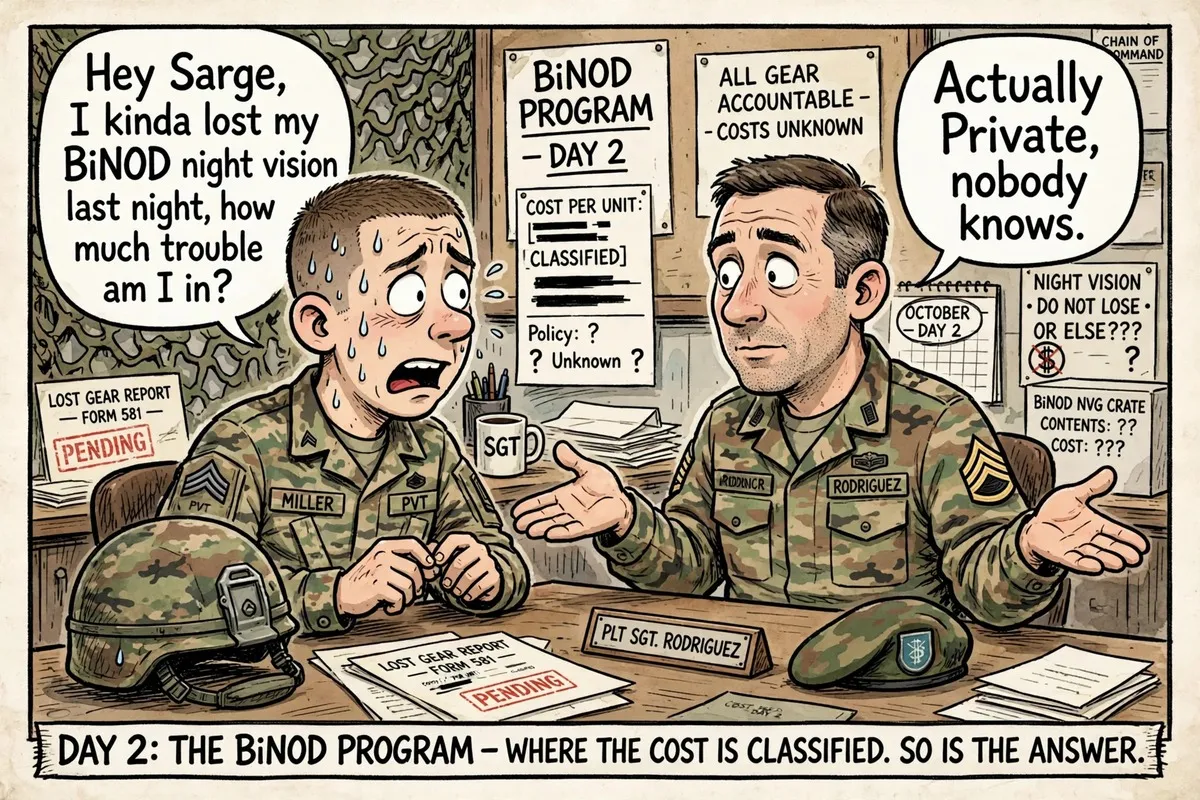
The story thus far: Day 1 laid out the claim: the Army's "low-cost" Binocular Night Observation Device (BiNOD) in at least one of its iterations is a commercial product, sold as "economical to purchase and own" for "the remainder of the force structure." Today we test the word economical as it used in certain circles; the beltway being one of them. More alarming perhaps for some, we are going to introduce the word verifiable.
The price tag
"Low-cost" was the pitch. Every program gets a pitch. The price tags are where pitches go to be tested, and BiNOD's price tags tell a stranger story than the pitch did. Any salesperson will tell you with a gleam in their eye that there’s nothing better than proving that you provided more for less money. They sold this idea on price, The truth is that they even alluded that the actual performance may be lower than systems that are already in the field. So while it is perfectly normal to not disclose the per unit price on an IDIQ, when you sell it based on that alone a normal person would feel obligated to share that detail. Alas normal people are hard to find in government.
At the Fort Benning industry day in 2021, Lt. Col. Christopher Kennedy put the program's target on the table: $6,000 to $8,000 apiece ($7,500 to $10,000 in 2026 dollars), for tens of thousands of systems.
It is certainly fathomable that a system that pre-sells on the commercial market for $10,176 from a dealer in Missouri for quantity one could be purchased by the US Government for at least $176 in savings when they buy them by the ton. That would be enough to bring the price into the envelope laid out wherever. Now what civilians pay. The NOVA, L3Harris's commercial variant of its proposed BiNOD system, retails from $10,176. That is the only retail listing I could find currently from a dealer in Missouri. Extra cool thing is that based on the dealer’s home page, it may actually come with a lifetime warranty - eat your heart out Uncle Sam.
The NOVA may be a little portly at 540 grams. It also does appear more like a Sega Genesis cartridge perched on top of two laid over salt shakers than the future of after-dark combat (credit to Reddit on this one). Fact is that the specs on the NOVA are pretty good. This is good seeing as they aren’t promoting this as an individual soldier capability improvement. So it does effectively stay in its lane (well except for some things we are going to discuss another day). Here’s the thing though; there are already smaller players in the industry selling superior products for less money. I make no secret that I sell night vision for a living and we assemble a for-government version of the MH-1 that is TAA compliant and superior to the NOVA in every way based on the specs. There are those that argue the MH-1 even compares favorably to the PVS-31A. I happen to concur, but you can check it out for yourself if you like.
Circling back to where we started, on October 12, 2026, L3Harris received a $55 million full-rate production award for NOVA systems. The award discloses no unit price and no quantities. You cannot divide $55 million by anything and get a per-goggle cost, because the Army and L3Harris didn't give you a denominator. That absence is what we should all be asking about. Again, they have no legal reason that they have to disclose it, but they sold the idea based on it being CHEAP and a universal truth is when you sell something based on price, you have to tell the customer the price. In this case the US Army made the pitch based on price and the customer is the American people.
Makes me miss Elon and the DOGE. Imagine suited middle aged nerds storming the Pentagon, and ok probably getting stopped in the parking lot, but humor me by imagining Elon holding up a grip of papers labeled SECRET in red and proclaiming the waste discovered. OK, really I don’t wish this on anybody in the armed forces but it did amuse me for a moment.
There really isn’t enough data to do any analysis on the other two probably-awardees of the BiNOD program (at least not that I know of) so for now we will have to pause on this matter.
Here’s the cliffhanger: if the goggles are pretty much the same, the tubes are still white phosphor, and the optics are mil-spec, then where exactly is all this money going to be saved?